Table Of Contents :
Introduction.................................Page One
Myth Rationale.............................Page Two
Quote Reflection...........................Page Three
First Source..................................Page Four
Second Source..............................Page Five
Third Source.................................Page Six
Fourth Source...............................Page Seven
Second Quote Reflection................Page Eight
First Source...................................Page Nine
Second Source...............................Page Ten
Third Source..................................Page Eleven
Fourth Source.................................Page Twelve
Conclusion.....................................Page Thirteen
Works Cited...................................Page Fourteen
Wednesday, January 12, 2011

Introduction

Deceit is prevalent everywhere in society. From 'little white lies' that people tell, to one big lie that turns into a whole web of lies that is almost impossible to escape from without coming clean, it's everywhere. But the question is, is all deceit necessarily bad? What if you are lying to someone to spare their feelings or to boost their confidence? Is it really that bad to tell a small lie to someone if you believe that it will be helpful to them? Or even to tell a small lie to help yourself. As long as no one is getting harmed, it's not a big deal, right? The thing is, how can you predict what that one lie will turn into? How do you know that no one will get hurt?
Myth Rationale : The Wooden Horse of Troy

The war between the Greeks and the Trojans is in its tenth year. The Trojans rejoice when they wake up one day to find that the Greek army has finally departed. They have left behind them a strange gift – a giant wooden horse. The Trojans are divided – should they set fire to the statue or should they honour and worship it?
The original for our adaption can be found Book II of the Aeneid by the Roman Poet Virgil. The Greek poet Homer only mentioned it in passing. This partly explains the famous line with an anti-Greek sentiment, “I fear the Greeks, especially when they are bringing gifts.”
Read by Natasha. Duration 12 Minutes.
The happiest day in the history of Troy was when the Greek army sailed away. For ten long years the war had raged, and many of the finest and bravest warriors on both sides, had fallen in battle. How the Trojans rejoiced as they walked along the shore where the Greek enemy had camped! Here, cruel Achilles had set up his tent. There, the arrogant King Agamemnon had commanded his men. And now, for the first time in their lives, the children of Troy could run and play in the foam of the sea, and teenage boys and girls could walk hand in hand beneath the cliffs.
But little did they realise, that the enemy army had not set sail for far-away Greece. Instead, they had only taken their ships to the other side of the island called Tenedos, and there they were lurking, out of sight, but still not far away. It was all a cunning trick thought up by the wiliest of the Greeks, the red haired Odysseus, who was never short of a plan.
The Trojans saw that the Greeks had left behind a strange offering. It was a giant wooden horse with ribs made from the planks of fir trees. The people marvelled at the massive statue, but there were different opinions about what they should do with it. Some wise old men saw there was something not quite right about the horse, and advised that they should set fire to it straight away. Others warned that , the gods would be angry with them if they did not honour the statue. After all, the wooden horse was dedicated to grey-eyed Athena, the great goddess of wisdom, and nobody wanted to feel her wrath.
The crowd was wavering, and a white-bearded old Priest spoke out above the murmur. “Fellow citizens. Whatever this strange horse may be, remember this: it is always wise to fear the Greeks, especially when they are bringing gifts. By the Great God Poseidon, Lord of the Seas, and by everything that is sacred, let us not fall into this deadly trap, for that is what is surely is! ”
So saying, the old priest hurled a mighty spear at the horse, and and it flew into the beast’s side and quivered, and the guts of the horse reverberated with an eerie hollow sound like a long, deep moan. And had the Trojans decided there and then to set fire to that horse of death, their lovely city would be standing to this day, and the descendants of King Priam would be living in peace and happiness.
But just then, a Trojan patrol came upon the scene, and they brought with them a prisoner – a Greek called Sinon whom the army had left behind.
“Now we will find out the truth!” said the Trojan guards. “Let’s poke this wretched Greek spy with our bronze Spears until he tells us what this Greek gift is all about!”
When he heard this, the poor prisoner cried out: “No, please! Don’t harm me. I’ll happily tell you all you want to know, for cruel, scheming Odysseus is no more a friend of mine, than he is of you.”
And so the Trojans listened to what Sinon had to say, and they tried to fathom whether or not he spoke the truth.
“Do you not think that the Greeks would have gladly given up this war before ten long years had had passed? Let me tell you that many times they planned to leave their sufferings behind, as they have done no. . But each time they prepared to sail way in their beaked black ships, the sea-god Poseidon sent a terrible storm, and whipped up giant waves on the wine dark sea. Eventually, they consulted a priest who told them the reason why the gods were inflicting such pain. You see, before he left his home in Argos, King Agamemnon, the great leader of men, waited an entire month for a wind to blow his ships to Troy. Eventually, he decided that the gods required a very special offering. And as usual, it was scheming Odysseus who thought up the plan. He sent for Agamemnon’s own daughter, his darling Iphigenia, and told her that she was to marry swift-footed Achilles. She came with great joy and gladness in her heart, for Achilles was the handsomest and bravest of the Greeks, but it was all the most dreadful trick. Instead of marrying Achilles at the alter on the cliffs high up above the sea, the priest sacrificed the lovely white-skinned young maiden to the sea-god. And straight-away that the foul dead was done, the winds began to blow.
“Now, ten long years later, as we were waiting for a wind to take back home, Odysseus came up with another plan. “I know,” he said, “Let’s sacrifice the most useless of those among us. Nobody will miss Sinon. He has only ever criticised our plans, and called us leaders wicked and foolish. We once sacrificed an innocent young girl, now let’s give the gods the life of a man, and you’ll see, they will send us a fair wind to blow us swiftly home.”
“But before Odysseus sent his guards to fetch me to my death, a rumour reached me of what he had said, and I ran into the woods and hid. And so the Greeks came up with a second plan to appease the Gods. And you see the result before you. This magnificent wooden horse is their offering, to say how sorry they are for all the needless death and destruction they have caused. Only bring it inside your walls before night falls, because unless I am far wrong, there will be gold and treasure hidden deep inside the belly of that wooden horse.”
And when the Trojans had heard Sinon’s tale, many of them were greedy for treasure, and they believed his wicked lies – for he spoke very convincingly. But still the crowd was uncertain what to do – until, that is, a most terriblel thing happened. The old priest who had thrown his spear at the horse, was standing by the sea, when a great monster came swimming into shore and carried him off its jaws. It all happened in a flash, and the Trojans were filled with a strange terror.
Sinon one again called out: “You see, you Trojans. Nothing but the truth I spoke! The Gods have rightly punished that wicked old priest for sending his spear into the wooden horse!”
And now nobody dared to disagree. And the Trojans brought ropes and placed wheels beneath the statue’s feet, so that they might pull the wooden horse through the gates of their magnificent city. And as the ill-omened procession entered Troy, girls and boys danced around the horse singing holy chants. There was rejoicing in the city, and even the fortune teller, Casandra did not dare open her lips, though she foresaw the imminent doom. For the gods had given Casandra the gift of clear-sighted prophesy, but had decreed that not one person would believe her.
It was a clear moon-lit night, and the Trojans carried on partying. Sinon the Greek had been set free, and nobody noticed that he lit a fire on the beach to signal to the army on the island of Tenedos that the wooden horse was within the walls of Troy. Next he returned to the city, and opened a secret door in the belly of the horse. And the Greek band of warriors, who had been hiding all that time within, let down a long rope- and they were led to the ground, by wily Odysseus, who was the first of them to stand in the central square of magnificent Troy.
It was not long before the Greek intruders had surprised the guards on the main gates and killed them. Soon the wide doors were open, and the Greek army was surging into Troy. The Trojans were either drunk or sleeping, and in no way ready to fight. On every side the city was in turmoil. Soon the palace of King Priam was in the grip of fire, and Helen – the most beautiful woman in the world, for whom these ten years of war had been fought, was throwing herself at the feet of her Greek husband, King Menelaus, and protesting how she had been kidnapped and brought to Troy against her will. It was all lies, of course, but Menelaus was ready to be believe his lovely wife, and took her once more in his arms.
_______________________________________________________________
Myth Source : The Wooden Horse of Troy
The Wooden Horse of Troy is a perfect myth for my theme of Deceit. The entire plot of the story revolves around the fact that, to win the war and to rescue Princess Helen, the Greeks deceived the Romans. They made it look like they had given up the war, and that they sent the Horse as a peace offering, when it was, in reality, a crafty plan devised by Odysseus to win. This relates perfectly to my first quote, which is “Excessive courtesy must contain deceit." The Greeks hid within the giant horse, and waited as the Romans saw the gift, interpreted it as a peace offering, and took it within their walls. This was what lead to their destruction, which might not even have happened had they been more suspicious of the Horse in the first place. This theme is also prevalent within our own modern days. When there is someone who hasn't been all that nice to you in the past, but starts very abruptly, there is most likely an ulterior motive. Whether the motive is driven by guilt, or for personal gain, there is still that motive in play. And if that motive happens to be personal gain, there is surely deceit hidden under it all. So, having said this, within this project I hope to explore both sides of deceit. The side where good is intended, and the side where it is, unfortunately, not.
First Quote

"Excessive courtesy must contain deceit" - unknown
As previously stated within my myth rationale, ulterior motives are present almost every day. Whether it be accompanied by unusual kindness, or whether deception is intended to get what one wants, it's everywhere. This quote in particular, explores the fact that too much kindness must contain some traces of deceit. Whether it be like the Trojan Horse, where the kindness is really a plot of destruction or perhaps where the kindness is intended for just a small personal gain. The excessive kindness does not necessarily need to have selfish roots, however, it could be to make someone feel better about themselves, or to protect their feelings. One of the scenarios I have found that happens quite often is when someone has bad news to tell you, so the little while leading up to the news, they are kinder than usual. This excessive kindness in any scenario does not go unnoticed, however. It usually causes suspicion, which can lead to bigger and greater problems. So, I think the question is, is deceit really good in any form? Even in the ones intended for good?...
First Source : Lie To Me by Jonny Lang

Source One : Lie To Me, By Jonny Lang
"Lie to me and tell me everything is all right
Lie to me and tell me that you'll stay here tonight
Tell me that you'll never leave
Oh, and I'll just try to make believe
That everything, everything your telling me is true
Come on baby won't you just
Lie to me, go ahead and lie to me
Lie to me, it doesn't matter anymore
It could never be, the way it was before
If I can't hold on to you
Leave me something I can hold onto
For just a little while won't you, won't you let me be
Oh, anyone can see
That you love him more than me
But right now baby let me pretend
That our love will never end
Lie to me, go ahead and lie to me"
_________________________________________
...Is it truly good to lie to someone to make them believe that everything is okay, when, clearly, it is not? In this song, Jonny is asking for just that. He wants to be told that she loves him the most, that everything will be okay, and that she'll never leave him. Suppose 'she' complies with this request. She tells him everything he wants to hear. Surely it would make him feel better initially, but when the truth does come out it just sets him up for a greater fall. Even though he knows that it would be a lie, sometimes people can manage to convince themselves that a lie is true by repetition. They persuade themselves to believe what they want to believe instead of what they know is true. Therefore, wouldn't one want to be told the truth outright, instead of later, when in reality, they've been suspecting it all along? Take the example of someone cheating on their significant other. Let's also say that a friend of their significant other catches them in the act. This creates a dilemma. Do they tell their friend about what they saw, and risk them 'shooting the messenger'? Or do they keep the secret from them and make excuses for themselves, so they feel better? If you decide to tell them, they are almost sure to go into denial, but, when they do accept the truth, it's better than them finding out later. In situations like these, honesty is almost always the best policy...
Second Source : Macbeth by William Shakespeare

"MACBETH.
My dearest love,
Duncan comes here tonight.
LADY MACBETH.
And when goes hence?
MACBETH.
To-morrow,--as he purposes.
LADY MACBETH.
O, never
Shall sun that morrow see!
Your face, my thane, is as a book where men
May read strange matters:--to beguile the time,
Look like the time; bear welcome in your eye,
Your hand, your tongue: look like the innocent flower,
But be the serpent under't. He that's coming
Must be provided for: and you shall put
This night's great business into my despatch;
Which shall to all our nights and days to come
Give solely sovereign sway and masterdom.
MACBETH.
We will speak further.
LADY MACBETH.
Only look up clear;
To alter favor ever is to fear:
Leave all the rest to me.
[Exeunt.]"
______________________
Deceit is a predominant theme in Macbeth. Macbeth goes to serious measures to achieve the power he eventually has over Scotland. Although, due to his questionable and deceitful methods of getting that power, he is unable to hold it for that long. And it is not just Macbeth who is deceitful in the play. At the beginning, there is the betrayal by the Thane of Cawdor. The characters who I believe are most deceitful, however, are the three witches. The witches use the mask of 'kindness' to make Macbeth's worst nature hunger for the power that is predicted he will have. They tell him that he will be Thane of Glamis, Thane of Cawdor, and, on top of it all, king of Scotland. And although this is, in essence, true, the Witches make it seem to Macbeth that he will be king for a good long while, as opposed to being overthrown by Macduff so soon after his rise. As well as this, Macbeth is soon hiding his true ambitions behind a mask or kindness. He invites King Duncan over for a seemingly pleasant dinner, when his real motives are to murder him for the crown. There are a few lines Lady Macbeth speaks to encourage Macbeth that deceit is the proper path. “Look like th'innocent flower, but be the serpent under't.“ And this is exactly what Macbeth does...
Third Source : Harry Potter and the Deathly Hallows by J.K. Rowling

Source Three : The Harry Potter Series
"'Don't look so shocked, Severus! How many men and women have you watched die?'
'Lately, only those whom I could not save. You have used me.'
'Meaning?'
'I have spied for you, and lied for you, put myself in mortal danger four you. Everything was supposed to keep Lily Potter's son safe and now you tell me you have been raising him like a pig for slaughter?-'
'But this is touching, Severus,' said Dumbledore seriously. 'Have you grown to care for the boy, after all?'
__________________________________________________________
...Throughout the entire series, Snape has been dishonest with Lord Voldemort. He has convinced him that he is indeed on his side, and is working as a spy for Dumbledore. His true loyalties, however, lie with Dumbledore and the Order of the Phoenix. His job is to give certain pieces of information to Voldemort, just enough so that he still thinks him a credible source, but not enough that their plans are given away. It is a very difficult and dangerous job and only one like Snape, with an incredible flair for dishonesty can pull it off. So here we would have a classic double agent scenario. Snape is deliberately being ‘kind’ to Voldemort so as to remain in his deepest confidences, but there is the fact that he is not really on his side under it all. This is, I think, a magnificent example of “excessive courtesy must contain deceit.” Snape is as courteous to Voldemort as possible, does his bidding, and finds information for him, and all the while is disloyal and, in reality, should not be trusted by Voldemort. In this series, deception definitely moves the plot forward in many ways. And so it is, I believe, with many book series’...
Fourth Source : Othello

Source Four : Shakespeare’s Othello
"OTHELLO : O misery!
IAGO : Poor and content is rich, and rich enough,
But riches fineless is as poor as winter
To him that ever fears he shall be poor.
Good heaven, the souls of all my tribe defend
From jealousy!
_____________________________
...Iago is a master of deception. His plots are sophisticated and carefully manipulate Othello into believing Desdemona is disloyal. He is an intelligent villain, has intense patience, and has a wonderful understanding of Othello’s behaviour, and what he would do in certain situations. Similar to Shakespeare's Macbeth, Iago uses skillfull manipulation of all those around him to get what he wants. Using this knowledge of how to mold the human mind, he carefully devises a scheme that works all too well in the end. He pretends to be looking out for Othello’s best interests, when in reality, it’s the opposite. However, by the end of the play, when Iago refuses to tell Othello of his destructive motivations, it seems that his character is deceiving the audience as well as Othello. We have watched the play believing that the truth will be revealed to us, and why Iago is manipulating Othello is such a manner, but we never truly find out. So, in this play, it seems that the ultimate deception is not made towards any of the characters, but to us. Which is, I believe, the most clever deception of them all...
Second Quote

"The easiest person to deceive is one's self" -Edward G Bulwer-Lytton
First of all, let's use the example of not exactly lying, just slight truth-bending. Say someone is about to get you into trouble, and you bend the truth slightly so that the blame is shifted upon someone else, and you repeat it enough times. In a circumstance such as that, you might be able to convince yourself that what you're saying is, in fact, true. When trying to convince other people of a lie, unless you are extremely skilled in the art of deception, they are likely to sense that something is not quite right about what you are saying. If you are trying to convince yourself of something that you know is not true, it's slightly easier. It's much harder to fess up to something, and then have to deal with the consequences, but if you really WANT to believe something is the truth, why can't you? You will make up all sorts of excuses that you are willing to tightly grab hold of, as a way out, that other people might not be so eager to grasp. You might want to be able to hold on to these flimsy excuses that you can come up with, but if it's another person who wants to see justice served, they're going to critically analyze everything from what comes out of your mouth to your body language. This is why I find this quote to be true. Because you're eager to accept lies, whereas someone else might not be.
First Source : The Hunger Games by Suzanne Collins

Source One : The Hunger Games by Suzanne Collins
"'Handsome lad like you, there must be some special girl. Come on, what's her name?" says Caesar.
Peeta sighs. "Well, there is this one girl. I've had a crush on her ever since I can remember. But I'm pretty sure she didn't know I was alive until the reaping."
Sounds of sympathy from the crowd. Unrequited love they can relate to.
"She have another fellow?" Asks Caesar.
"I don't know, but a lot of boys like her," says Peeta.
"So here's what you do. You win, you go home. She can't turn you down then. eh?" says Caesar encouragingly.
"I don't think that's going to work out. Winning...won't help in my case.," says Peeta.
"Why ever not?" says Caesar, mystified.
Peeta blushed beet red and stammers out. "Because...because...she came here with me."
________________________________________
In Suzanne Collins' novel "The Hunger Games", set in a post-apocalyptic world in which children are forced to participate in a fight to the death on live Television just so the Government can show them that they have complete control over everyone. They randomly pick a boy and a girl from each outlying district from the Capitol (there are 12) to compete. The protagonist, Katniss Everdeen, is thrown into the Games with fellow District 12 tribute Peeta Mellark. When Peeta reveals to the country that he is in love with Katniss, she doesn't believe him. She thinks his genuine affection for her is just a clever strategy to get ahead in the Games by making her feel 'emotionally attached.' Throughout the book, this is her main deception to herself. She misreads every signal Peeta gives off, assuming it's just for the purposes of winning over the audience. And, finally, when the rules of the games are changed so that there can be 2 victors instead of just one, just so long as they are from the same District, Katniss plays along. She finds Peeta within the arena, injured and on the brink of death, and nurses him back to life. She plays the part of his 'significant other' so well, in fact, that she convinces not JUST the viewers, but Peeta as well. And even when it all blows up in her face and Peeta finds out that it was just for show, she still doesn't believe his true feelings for her. And she, in turn, doesn't realize her true feelings for him either. It is in this fashion that Katniss deceives herself, which is opposite of the way that Jonny lang uses deception. In "Lie to Me" Jonny deceives himself into thinking that everything is okay, and that she still loves him. Katniss, however, attempts to convicne herself that there is no emotional connection between her and Peeta, when it gets increasingly obvious though the book that there is...
Second Source : Say Anything...
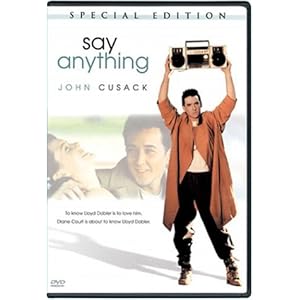
...In the popular 1980’s movie Say Anything..., Diane Court is told that her father is a crook. It is explained to her that her father, (who runs a Nursing Home) steals cash and other valuables from the elderly patients who have recently passed away. Upon hearing the news, Diane is, at first, in denial. She outright refuses the claim that her father could be involved in anything underhanded, even when she knows deep down that he fits the ‘portfolio’ described by the FBI agent who broke the news to her. When she returns home afterwards, she starts looking through all her fathers things, trying to find proof (or lack thereof) that her father is guilty. She is an intelligent girl, and she cannot just believe something outright, even if she wants it so much to be true. After searching through some drawers, etc. she stops herself and says that it’s pointless to look for anything because there is nothing to be found. She wants so much to be able to trust her father, whom she picked to live with over her mother during their divorce a few years previous. She suppresses her first instincts of doubt at his innocence, and tries very hard to convince herself that none of it is true. However, she eventually decides to look in one more place before deciding what to believe. Upon looking in a locked chest, she finds wads of cash, piled high. It is this moment that she realizes, despite trying desperately to convince herself otherwise, that her father is a criminal...
Third Source : Galveston By Paul Quarrington
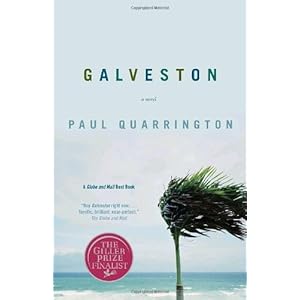
"He tried to put distance between himself and the thought whenever he could find a storm. And the bigger the storm, the grater the distance; someday he would find a big enough storm that he and the thought would be separated forever.
The thought was, as you may have guessed, nothing but the simple reflection that he had loved his wife Jaime very, very much. And Andy, who was made of their love."
__________________________________________________________
...This book is based on a three people who travel to the island of Dampier Cay in search of a hurricane. Three people who go to extremes just to feel alive. One of them, Caldwell, has been depressed and lost, in a sense, ever since losing his wife and child. By the end of the book, Caldwell comes to the realization that he truly loved his wife and son. He wasn’t necessarily deceiving himself before his realization, but he definitely wasn’t being honest with himself. The difference between the two is that, if he were deceiving himself, he would be almost consciously trying to convince himself of a fact. But by not being honest with himself, he is just not accepting his innermost feelings, which, in its own way, is a form of deceit...
Fourth Source : The Oprah Winfrey Show

...In one episode of the Oprah Winfrey show, there was a man who has been married to his wife for seven years, yet admitted on the show that he was homosexual. He was lying to himself and trying to pretend he was someone that he wasn't, and in not accepting himself for who he was, he spiraled into denial. Almost like the Romans in "The Trojan Horse". They beleived that the gift was exactly what it wasn't, a peace offering. And this man tried to convince himself to believe that he was also the opposite of what he truly was. He tried everything he possibly could to convince himself, and others, that he was straight. He got married to a woman and until the show, he never admitteed that he was actually homosexual. His wife made a statement saying that for the past few months of their relationship, she had an inkling that he wasn't completely telling the truth about his sexuality, but that she never suspected he was completely lying about who he was. I think it's sad when a person can't accept themselves for who they are, because the more they try to convince themselves they're someone else, the more difficult it is to finally face the truth...
Conclusion

...I have given it a lot of consideration throughout the course of assembling this project, and I have decided that not all lies are bad. Most of them are, because small lies said with perhaps good intentions have an annoying habit of turning into giant, black webs of deceit. But those lies that require no elaboration, are never mentioned again, and are said to boost someone’s confidence, why should they be bad? Sure, honestly is usually the best policy, but, in reality, what would the world be like if everyone was 100% honest 100% of the time? I would bet any amount of money that more people would be depressed, that people would get hurt more often, and that a lot of joyous times would be shattered. I mean, without those tiny little fibs assuring someone that they can, indeed do that something they’ve been dreading, or that they DO look great that day, a lot more people would be a lot more insecure with themselves. And with further consideration, I have also come to the conclusion that those tiny fibs are probably the only kind of lie acceptable, otherwise things can take a turn for the worse very quickly. Like Diane’s dad in Say Anything... lying to his daughter about being a crook was probably not a wise idea on his part. (Almost as unwise as him just being a crook.) So, finally, with the Tapestry project coming to a close, I just have to say that whether lying is good or bad depends solely on the situation in which lies are used and must always be used with caution, because one never can predict what a small lie can grow to become.
Works Cited
1 - Collins, Suzanne. The Hunger Games. New York: Scholastic, 2008.
2 - Quarrington, Paul. Galveston. Toronto: Vintage Canada, 2005.
3 - Shakespeare, William. Othello. Oxford: New Clarendon Shakespeare, 1968.
4 - Rowling, J. K. Harry Potter and the Deathly Hallows. Vancouver: Raincoast Books, 2007.
5 - http://storynory.com/2006/10/28/the-wooden-horse/
6 - http://www.literaturepage.com/read/shakespeare_macbeth.html
7 - Lang, Jonny. "Lie To Me" Lie To Me. A+M Records, 1997.
8 - http://www.laurafreberg.com/IsHeLying.JPG
9 - http://www.abc.net.au/reslib/200706/r151802_541786.jpg
10 - http://ri.rediffiland.com/homepimages/home4/828/16f3a7f55ca5a46e59128833e5bb2bfa/homep/images/1158313920
11 - http://www.windows2universe.org/mythology/images/ulysses_horse.jpg
12 - http://img94.imageshack.us/img94/5118/11980293.jpg
13 - http://www.falconlit.com/web/webquest/macbeth/macbeth_pic.jpg
14 - http://images.wikia.com/harrypotter/images/5/59/DeathlyHallowsCover.jpg
15 - http://www.pbs.org/shakespeare/images/works/othello-poster.jpg
16 - http://blog.todayter.com/wp-content/uploads/2010/11/truth_and_lies_t.gif
17 - http://ncowie.files.wordpress.com/2010/12/the-hunger-games.jpg
18 - http://ecx.images-amazon.com/images/I/41CTVK8CVSL._SL500_AA300_.jpg
19 - http://ecx.images-amazon.com/images/I/4125rfKjF9L._SL500_AA300_.jpg
2 - Quarrington, Paul. Galveston. Toronto: Vintage Canada, 2005.
3 - Shakespeare, William. Othello. Oxford: New Clarendon Shakespeare, 1968.
4 - Rowling, J. K. Harry Potter and the Deathly Hallows. Vancouver: Raincoast Books, 2007.
5 - http://storynory.com/2006/10/28/the-wooden-horse/
6 - http://www.literaturepage.com/read/shakespeare_macbeth.html
7 - Lang, Jonny. "Lie To Me" Lie To Me. A+M Records, 1997.
8 - http://www.laurafreberg.com/IsHeLying.JPG
9 - http://www.abc.net.au/reslib/200706/r151802_541786.jpg

10 - http://ri.rediffiland.com/homepimages/home4/828/16f3a7f55ca5a46e59128833e5bb2bfa/homep/images/1158313920
11 - http://www.windows2universe.org/mythology/images/ulysses_horse.jpg
12 - http://img94.imageshack.us/img94/5118/11980293.jpg

13 - http://www.falconlit.com/web/webquest/macbeth/macbeth_pic.jpg
14 - http://images.wikia.com/harrypotter/images/5/59/DeathlyHallowsCover.jpg
15 - http://www.pbs.org/shakespeare/images/works/othello-poster.jpg
16 - http://blog.todayter.com/wp-content/uploads/2010/11/truth_and_lies_t.gif

17 - http://ncowie.files.wordpress.com/2010/12/the-hunger-games.jpg

18 - http://ecx.images-amazon.com/images/I/41CTVK8CVSL._SL500_AA300_.jpg
19 - http://ecx.images-amazon.com/images/I/4125rfKjF9L._SL500_AA300_.jpg
Subscribe to:
Comments (Atom)